
Shaped Shutters
Tailored to fit
every curve, angle,
and architectural feature
Shaped shutters are made-to-measure to fit uniquely shaped windows, including arches, angles, and circular designs. They enhance unusual features while providing excellent light control and privacy, creating a seamless, tailored finish that complements your home.
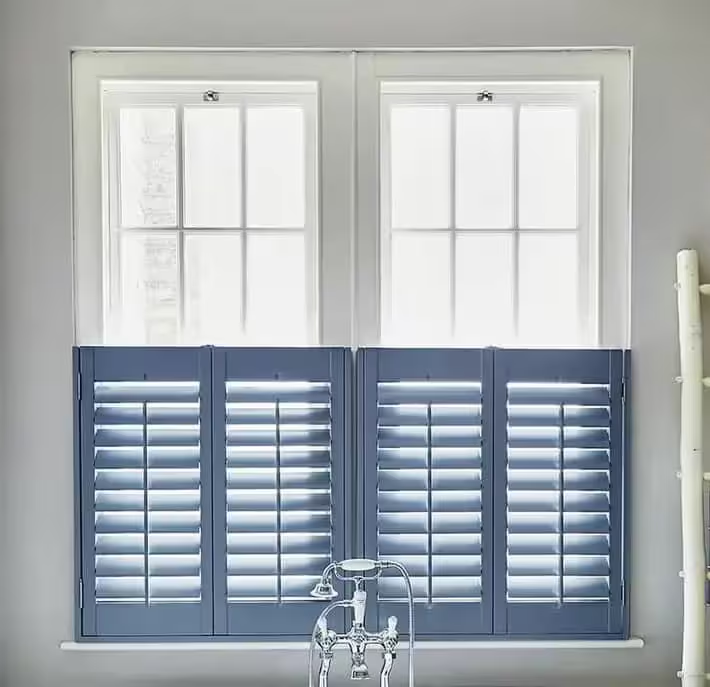
800×1000px — faux wood shutters

What Are Shaped Shutters
Shaped shutters are ideal for non-standard windows, delivering a precise fit without compromising on style or functionality. They highlight architectural features while offering privacy, light control, and a clean, custom look that feels truly bespoke.
Why Choose Shaped Shutters
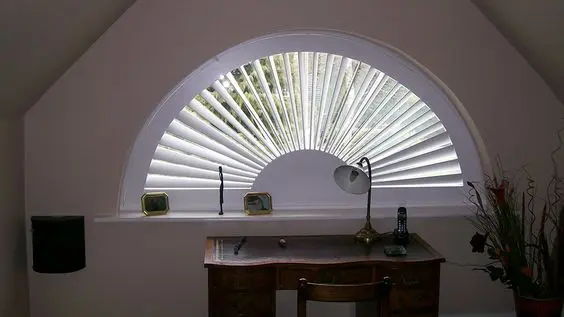
Arched tops, circular portholes, triangular gable windows, angled rakes — shaped shutters are made to fit the exact geometry of your window opening. Every frame and panel is cut and built to order, so there's no compromise on fit or finish.
Made for arches, circles, and rakes
Shaped shutters are built to fit arched tops, full circles, ellipses, quarter-circles, triangles, and angled rakes — any window geometry that a rectangular panel cannot cover. The frame is cut to the exact curve or angle of your opening, so the shutter sits flush against the reveal with no visible gaps.
Fixed or louvred panel options
Shaped sections can be built as a fixed solid panel (no louvres — purely decorative, blocks light completely when closed) or as a louvred panel with a tilt rod for light control. The choice depends on the window shape — tight arches and triangles suit fixed panels; wider ellipses and fan shapes can accommodate louvres.
Paired with full height or café style
Shaped shutters are most often installed above a full height or café style rectangular panel to cover the entire window opening — the shaped section sits in the arch or head, the standard panels cover the rectangular body below. Both sections are built in the same frame profile, louvre size, and paint finish so they read as one installation.
Fully cord-free throughout
Where louvres are included in the shaped section, they are controlled by a tilt rod — no cords or chains at any point. Fixed panel sections have no moving parts at all. The complete installation, shaped section included, meets current UK child safety regulations in its standard configuration.
Templated on site for accuracy
At survey, we take a paper or card template of the shaped opening rather than relying on measurements alone. This accounts for any asymmetry, plaster inconsistency, or slight deviation from true in the arch or curve — common in period properties. The template goes directly to the workshop to guide the frame cut.
Painted to match your full installation
The shaped section is painted in the same colour and finish as any rectangular panels below — standard white and off-white are stocked; custom RAL colours are available to order. Frame profiles are matched across both sections so the join between the arch and the rectangular body is clean and intentional-looking.
How Shaped Shutters Work
Shaped shutters follow the same frame-and-panel system as standard shutters — but the process of measuring, templating, and fitting the shaped section requires additional steps that a standard survey alone can't capture.
On-site templating of the shaped opening
At survey, we take a physical card or paper template of the shaped portion of the reveal rather than measuring with a tape alone. This captures any asymmetry, slight deviation from true, or plaster irregularity that measurements would miss — particularly common in Victorian and Edwardian arched openings where the curve is hand-plastered and not geometrically perfect.
Frame cutting and joining
The L-frame for the shaped section is cut and bent (for curves) or mitre-joined (for angled shapes) in the workshop using the template as a guide. Curved frame sections are steam-bent or laminated to follow the arch profile without visible joints on the face. The shaped frame section is then test-fitted before the panels are built to ensure the reveal fit is exact.
Fixed panel or louvred panel build
Once the frame is confirmed, the shaped panel is built either as a fixed solid face (no louvres — used for tight curves, small circles, and triangles where louvre geometry becomes impractical) or as a louvred panel with shortened louvres radiating from a central pivot on fan and ellipse shapes. The tilt rod is fitted where louvres are included.
Fitting and joining to the rectangular section
The shaped section is fitted first, followed by any rectangular panels below. A horizontal joiner rail connects the two sections cleanly at the point where the arch meets the rectangular body — this rail is part of the design and sits flush with both frame profiles. Paint finish and louvre size are matched across both sections throughout.
Limited time offer
Book your free survey and lock in 25% off today.
No obligation. No deposit. We come to you, measure every window, and give you a fixed price with the discount already applied.
Book a Free SurveyFree survey · 25% off all styles · Fixed price · Professional fitting includedHow Our Shutter Service Works
We like to do things a bit differently. No hidden costs, no confusing small print, just clear, upfront pricing. Plus, with the UK’s most thorough price beat promise, you’ll always know you’re getting the best deal.
Book An Appointemt
Book a FREE in-home appointment with your local Shutterly Fabulous specialist
Free Home Visit
Your local Shutter Specialist will measure up, explore design options, and provide a tailored quote.
Installation Day
The same Specialist returns to install. All you have to do is sit back, relax, and enjoy the fabulous transformation.
Shaped Shutters FAQs
What window shapes can shaped shutters be made for?
Shaped shutters can be built for arched tops (full arch, eyebrow arch, and gothic point), full circles and ovals, quarter-circle corner windows, triangular and raked gable windows, and irregular geometric shapes. The most common request is a standard rectangular window with an arched head — where the shaped section covers the arch and full height panels cover the rectangular body below.
Can the shaped section have working louvres or is it always fixed?
Both options are available. Fixed panels — a solid face with no louvres — are used on tight arches, small circles, and triangles where fitting louvres isn't practical. Louvred panels with a tilt rod are possible on wider fan shapes, ellipses, and full arches where the louvre geometry works. We'll advise which is suitable for your specific window shape at survey.
How do shaped shutters join to the rectangular panels below?
A horizontal joiner rail connects the shaped section to the rectangular panels at the point where the arch meets the flat glazing below. This rail is part of the designed frame system — it sits flush with both profiles and is painted to match. The result is a single cohesive installation rather than two separate components placed next to each other.
Why does a shaped window need templating rather than just measuring?
Arched and curved window openings in older properties are rarely geometrically perfect — the plasterwork is hand-applied and the curve often deviates from true by several millimetres across its span. A tape measure gives you the overall dimensions but misses this variation. A physical template captures the exact shape the frame needs to follow, preventing gaps and misfit at the reveal edge.