
Vertical Blinds
Made to measure
vertical blinds
for every opening
Measured, made, and fitted by our own team. The go-to choice for patio doors, bay windows, and large glazed openings – vertical blinds give you precise control over light and privacy without a blind taking up any floor space.
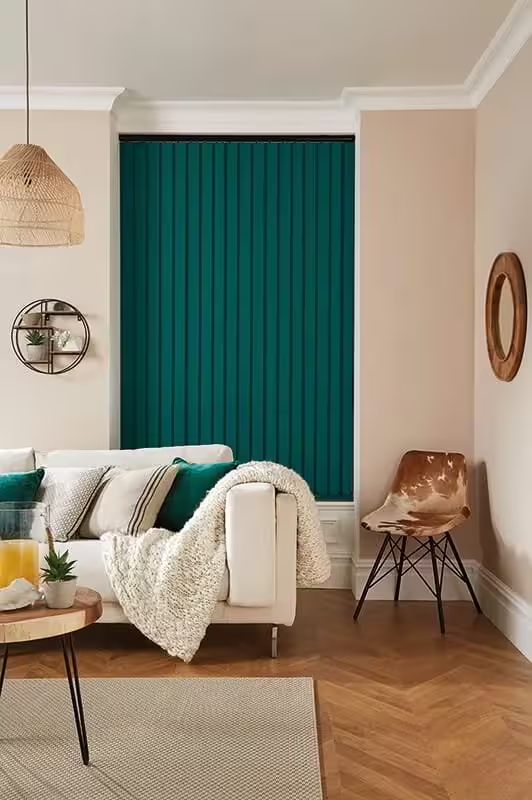
How a vertical blind works
The Mechanism
Two controls.
One simple system.
A vertical blind has two separate controls, traverse and tilt. The traverse wand slides all the vanes along the headrail track to stack them to one side, opening the blind completely so you can walk through a door or see the full window. The tilt wand rotates every vane at the same time, letting you angle the light without moving the blind across at all.
On wide patio doors the headrail can be split in the centre so vanes draw to both sides independently. Every blind is made to your exact measurements, so the vanes hang straight from headrail to floor with no gaps at the sides.
89mm or 127mm vanes
The standard 89mm vane suits most windows. The wider 127mm is better for very tall drops, fewer vanes means fewer gaps when fully closed.
Centre-split headrail available
On wide patio doors a split headrail lets vanes draw to each side independently, open one half while the other stays closed, or clear the whole doorway.
Child-safe wand control as standard
No exposed looped cords. A single wand operates both traverse and tilt, making it safe for homes with young children at no extra cost.
What sets them apart
Six reasons to choose vertical blinds
Not every blind type works on every opening. Here's where vertical blinds genuinely outperform the alternatives.
Spans that other blinds can't match
A single vertical blind headrail can cover up to 600cm width. Roller or roman blinds on the same opening would need multiple panels with visible joins between them, a vertical blind gives you one clean, unbroken covering.
Precise light-direction control
Tilting the vanes lets you direct light up toward the ceiling or angle it away from a TV screen. You get a finer level of control than a roller blind, which is either up or down with nothing in between.
Clears completely away from the door
Because vanes stack neatly to the side, you can open a patio door fully without the blind getting in the way. Other blind types often need a recess above the frame to retract into, vertical blinds don't need any extra clearance.
Replace a vane, not the whole blind
If a vane gets bent or damaged it unclips and a new one clips straight back in. You don't need to replace the headrail or the entire blind. Over time this makes vertical blinds one of the most cost-effective window treatments to live with.
Handles direct sunlight well
The vertical hang means the fabric isn't baking flat in one position all day, which extends fabric life. Angling the vanes also lets you block glare at a specific angle without losing your view outside entirely.
Commercial-grade build in your home
Vertical blinds are the most commonly specified blind in commercial settings, built for daily use on large glazing. The same robust headrail and track system and the same commercial-grade fabrics are available for domestic installations.
Vertical Blind Prices
How much do vertical blinds cost
Vertical blind costs depend on more than just window size. The final price is influenced by the fabric, the quality of the mechanism, and whether the blinds are made to measure.
Small Windows
50cm (500mm) W x 90cm (900mm) H
Prices From:
£31measured & fitted
Medium Windows
95cm (950mm) W x 120cm (1200mm) H
Prices From:
£43measured & fitted
Large windows
180cm (1800mm) W x 120cm (1200mm) H
Prices From:
£59measured & fitted
Tilt & traverse
Three vane positions.
Infinite in between.
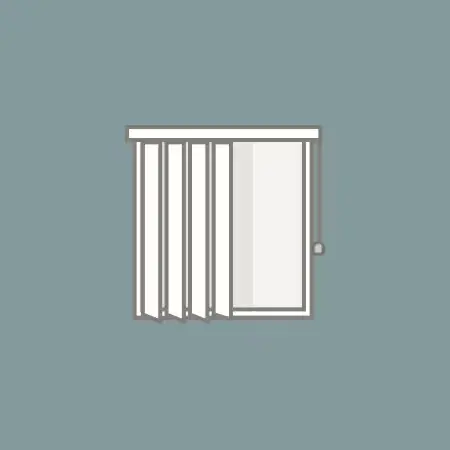
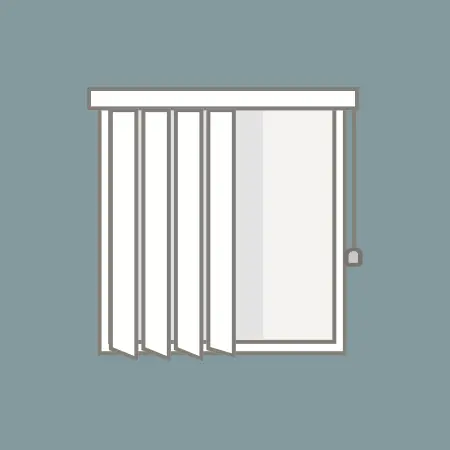
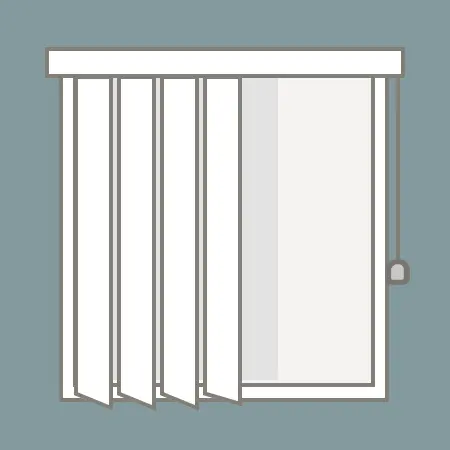
The tilt control rotates every vane simultaneously. Open them edge-on to let in full light. Angle them at 45° to direct sunlight and keep privacy. Close them face-on for maximum coverage. Every position between these three is available, it's not just open or shut.
Open
Vanes edge-on — full light and view
Angled
Vanes at 45° — directed light, partial privacy
Closed
Vanes face-on — maximum privacy and light block
Open — full light, full view
When vanes are rotated edge-on, they present their narrowest face and light passes through the gaps almost unobstructed. The blind is technically across the opening but lets through nearly the same light as if it weren't there. You can still see outside and the room feels fully lit.
Angled — directed light and daytime privacy
Rotating vanes to around 45 degrees is the sweet spot for most daytime use. It blocks the direct sightline through the window so neighbours can't see in at eye level, while still letting plenty of diffused natural light into the room. Good for desks where screen glare is a problem.
Closed — privacy and light blocking
Vanes rotated face-on overlap slightly at each edge, blocking the view through. With blackout fabric this also blocks most light. Worth being honest about: very small gaps exist where vane edges meet the next, so no vertical blind is a true complete blackout. For maximum darkness, pairing with a pelmet above makes a real difference.
Traverse — stack to one side
Traverse is separate from tilt. The wand or cord draws all vanes along the headrail track so they stack compactly at one end, typically 15–25cm wide depending on how many vanes. On a centre-split headrail, vanes draw to both sides, leaving the middle completely clear. You can then use the tilt control on either stack independently to angle whatever remains.
How Our Service Works
What we do best
Transforming your windows should be simple. Our friendly team guides you from inspiration to installation, making the whole process easy and stress-free.
Browse Our Collection
Explore our wide range of blinds, shutters, awnings and curtains to find styles that suit your home.
Book An Appointment
Arrange a home visit with your local advisor for expert advice, window measuring, and personalised recommendations.
Free Measuring & Fitting
Once you’ve chosen your blinds or shutters, we take care of the rest. Everything is made to measure and professionally fitted for a flawless finish.
FREE NO OBLIGATION QUOTE
Choosing made-to-measure vertical blinds means you get a perfect fit, professional finish and long-lasting performance.
No guesswork. No DIY stress. Just beautifully fitted blinds tailored to your home.
- Accurate measuring by local specialists
- Advice tailored to your rooms and light
- Fabric and style samples to view at home
- No hard sell — ever
- A detailed, no-pressure quote
- A detailed, no-pressure quote
Fabric options
Choose the right fabric for the room
Vertical blind fabrics range from near-sheer to near-blackout. Fabric weight also affects how well vanes hang, a heavier fabric hangs straighter, which matters more on tall drops above 200cm.
Blackout
Blocks the maximum amount of light. The right choice for bedrooms and rooms where you need darkness during the day. Small gaps at vane edges mean no vertical blind is 100% room-darkening, a pelmet above closes the remaining bleed.
Dimout
Reduces glare significantly while keeping diffused natural light in the room. The most popular choice for living rooms, offices, and conservatories where you want to control brightness without cutting out light entirely.
Translucent / Sheer
Lets plenty of light through while softening the view from outside. Works well in conservatories and bright rooms where you want to keep the window feeling open and airy. Offers less privacy at night when the room is lit.
Textured & Patterned
Structured weaves and subtle patterns add visual interest without dominating the room. The vertical hang of the vane catches light differently as the tilt angle changes, making texture look particularly good in this format.
Headrail finish
Six headrail colours as standard
The headrail is the only visible hardware when your blind is fully open. We stock six finishes so it sits comfortably against your window frames, walls, or ceiling, and we'll advise you at the survey on which works best in your room.
- White
- Cream
- Silver Grey
- Anthracite
- Slate Blue
- Midnight
Best applications
Where vertical blinds work best
Vertical blinds have specific strengths. These are the situations where they're genuinely the right tool for the job, not just a reasonable option.
- 01
Patio and sliding doors
The most common reason people choose vertical blinds. The vanes traverse clear of the door so you can come and go without touching the blind, and it still covers the full glazing when closed. No other blind type handles a sliding door as naturally.
- 02
Wide bay windows
A single vertical blind can span bay window widths that would need three or four roller blinds side by side. One headrail, one control, no alignment headaches between panels. The result looks cleaner and is far easier to use every day.
- 03
Home offices with screen glare
The tilt control is genuinely useful at a desk. You can angle the vanes to cut direct sun off a monitor while keeping the room bright, something a roller blind can't do, since it either blocks the whole window or does nothing at all.
- 04
Conservatories and sun rooms
Conservatories heat up quickly in direct sun. Angled vanes deflect the worst of the heat while keeping the space bright and usable. The wide spanning capability also makes them practical for conservatory end walls and full roof-to-floor glazing.
- 05
Floor-to-ceiling glazing
Very long drops cause problems for roller and roman blinds, they can bow in the middle or look floppy at the bottom. A vertical blind hangs naturally from the headrail and stays straight regardless of how tall the drop is.
- 06
Rental properties and busy family rooms
Individual vane replacement means one damaged vane doesn't mean a whole new blind. They're robust, easy to wipe clean, and built for heavy daily use, which is why they've been standard in commercial and rental settings for decades.
Vertical Blinds vs Other Window Coverings
How vertical blinds compare to other choices
Choosing the right window dressing depends on how you use your space. Consider whether you need flexible light control, privacy during the day, or easy access through patio doors and large windows.
| Feature | Vertical Blinds | Roller Blinds | Curtains |
|---|---|---|---|
| Light control | Excellent, adjustable | Limited | Good but less precise |
| Privacy | High without blocking light | High when closed | High |
| Large windows | Ideal | Can feel heavy | Often bulky |
| Maintenance | Easy | Easy | More demanding |
| Space-saving | Yes | Yes | No |
FREE NO OBLIGATION QUOTE
Choosing made-to-measure vertical blinds means you get a perfect fit, professional finish and long-lasting performance.
No guesswork. No DIY stress. Just beautifully fitted blinds tailored to your home.
- Accurate measuring by local specialists
- Advice tailored to your rooms and light
- Fabric and style samples to view at home
- No hard sell ever
- A detailed, no-pressure quote
Customer reviews
What our customers say
"We had three sets fitted, two patio doors and a wide bay window. The centre-split headrail on one of the patio doors is brilliant. We can open just the half near the door handle and leave the rest closed. The vanes hang perfectly straight and the fitting was done neatly in a morning."
"I was sceptical because I'd seen some tatty office vertical blinds, but these are a completely different product. The dimout fabric is a lovely weight and the vanes hang without any curl or bowing even at over 2.4m drop. Exactly what the conservatory end wall needed."
"The wand control is brilliant , no cords for the kids to get into, and simple enough that they can open and close it themselves. One vane got knocked and bent. I rang up, gave them the fabric ref, and a replacement arrived cheaply in the post. Great service and a sensible product."
Browse the range
More blind types from Homefair
Vertical Blinds
Louvre vane blinds for wide spans and patio doors. Traverse to open, tilt to control light.
Roller Blinds
The everyday workhorse. Clean, minimal, and available in blackout, dimout, and translucent fabrics.
Wooden Venetian
Real wood slats with tilt control. Warm, natural look, best in living rooms and bedrooms away from moisture.
Day & Night Blinds
Alternating sheer and solid bands. Rotate to shift between open view and full privacy, all on one roller.
Common questions
Vertical blind FAQs
Straight answers to the questions we get asked most often. If yours isn't here, give us a ring, we're happy to talk things through before you book a survey.
What is the maximum width for a vertical blind?
We can make a single vertical blind headrail up to 600cm wide. Beyond that width, you'd typically use two blinds side by side with a small join in the middle. For patio doors and conservatory walls that span several metres, a split headrail, which draws vanes to both sides from a central point is often a more practical solution than two completely separate blinds.
Should I choose 89mm or 127mm vanes?
89mm is the standard size and works well for most window widths and drop heights. The wider 127mm vane is worth considering when your drop is over 220cm, fewer, wider vanes means fewer small gaps between them when the blind is closed. For short, wide windows, 89mm generally looks more proportionate and less heavy. We only offer 89mm on all our vertical blinds.
Do vertical blinds provide complete blackout?
No vertical blind gives a true complete blackout. Even with blackout fabric, very small gaps remain where each vane meets the next, and at the top and bottom of the drop. A blackout vertical blind will block the large majority of light, but for maximum darkness, in a bedroom, for example — pairing it with a blackout pelmet above the headrail significantly closes off the remaining bleed.
Can I open the door while the blind is closed across it?
Yes — the traverse function draws all the vanes along the headrail to stack at one side (or both sides on a split headrail), clearing the doorway entirely. The vane stack is compact, usually 15–25cm wide depending on the number of vanes, so it doesn't significantly reduce usable door width. You can leave the blind traversed open and still use the tilt wand to angle the stacked vanes if needed.
Are cord-free vertical blinds available?
Yes. Wand-operated vertical blinds have no exposed looped cords. A single wand handles both the traverse (push or pull to open and close the blind) and tilt (rotate to angle the vanes). This is the child-safe option we recommend for all homes with young children, and it's available as standard, there's no additional charge for a wand mechanism over a cord version.
One vane has been damaged do I need a whole new blind?
No. Individual vanes clip in and out of the headrail carriers, so a damaged vane can be replaced without touching the rest of the blind or the headrail. We'd suggest noting your fabric reference at fitting time so we can match it accurately if you need a replacement vane later. Most fabric ranges remain available for several years, so matching up is usually straightforward.
How do I clean vertical blind vanes?
Most fabric vanes can be wiped down in place using a slightly damp cloth or lint-free duster, tilt them to one position first to make it easier. For a deeper clean, vanes unclip from the headrail carriers and can be hand-washed individually in cool water, then rehung straight to drip-dry. Never machine wash or tumble dry, as this shrinks the fabric and means the vane won't hang straight afterwards.
Do you fit vertical blinds in conservatories?
Yes, conservatories are one of the most common places we fit vertical blinds. We can cover end walls, side walls, and full roof-to-floor glazed sections. One thing worth knowing: conservatories can get very warm in summer, and prolonged heat can cause some fabric types to develop a slight bow over time. We'll advise on the most heat-stable fabric options when we come out to survey the space.
Ready to get a quote?
We'll come to you, measure up accurately, bring fabric samples along, and give you a fixed price on the day, no obligation and no surprises. We cover the North East and North West.
Free home survey · Fixed price on the day · North East & North West England